Combat system
The fight is automatic. The outcome is not.
You do not aim attacks in Dungeonbound. You decide what is on the board, where it sits and when it fires. This page explains the rules behind the animation, with the patch-dated details that changed them.
- Turn order
- Speed
- Speed baseline
- 10
- Burn tick
- 1.5s
- Fatigue
- 60s
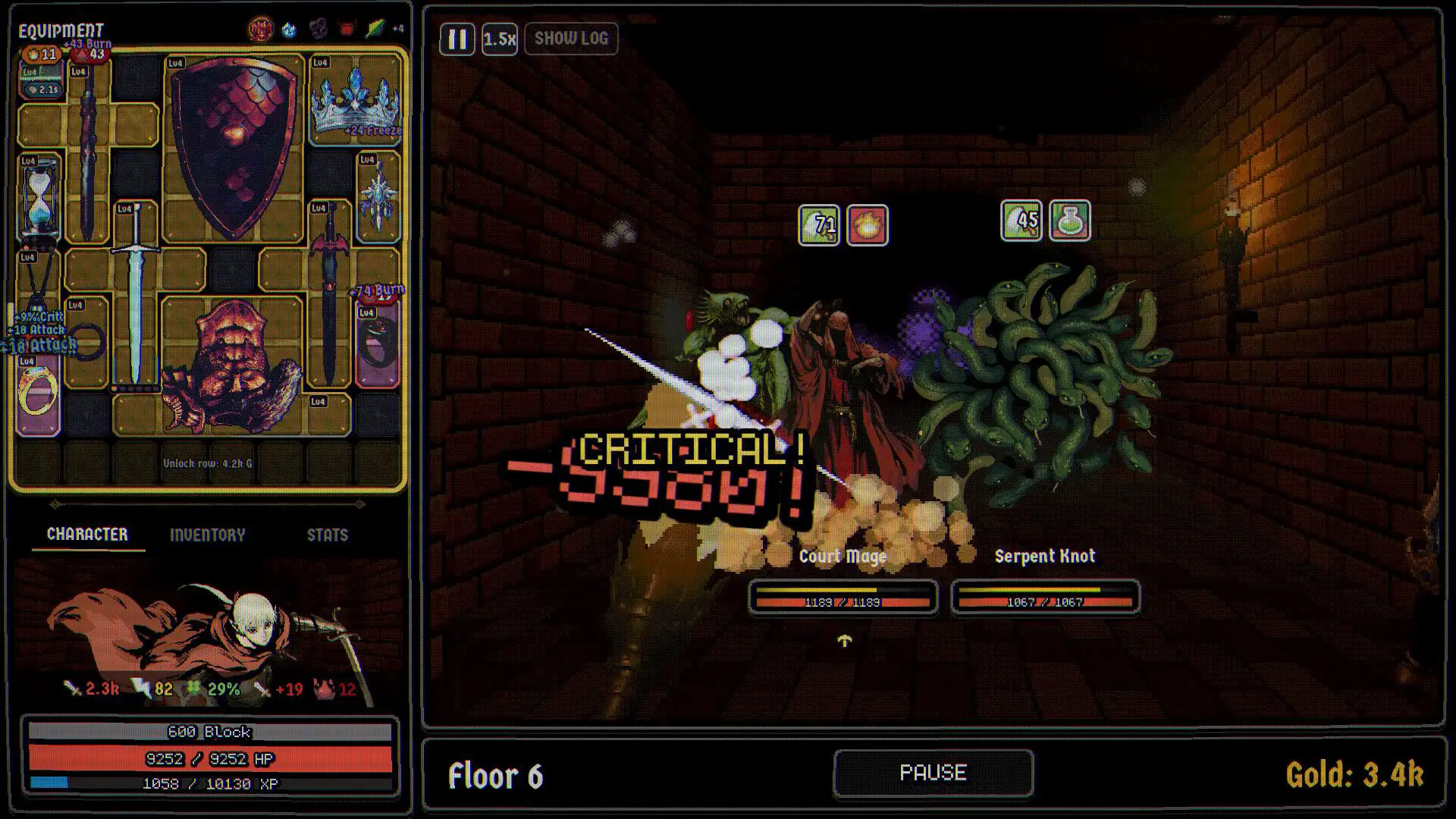
Official Steam screenshot
The damage packet
- 1 Dodge check
- 2 Crit roll
- 3 Damage type vs defence
- 4 Block absorbs
- 5 Overkill spills
A simplified order, not a published formula. The game does not expose exact damage math.
How a fight resolves
The official description is compact: attacks, dodges, crits, counters and status ticks all resolve on their own in speed-driven turns. The player's job is done before the fight starts, when the board is packed and the hero is chosen.
A useful mental model:
- Speed decides who acts. A faster unit acts more often; outpacing a slow enemy can earn extra swings.
- An attack sweeps the board. Every item the sweep passes fires. Placement determines what fires, and in what order.
- The target's defences check the hit. Dodge can avoid it; Block absorbs physical damage; Magic Resist covers magic.
- Crit multiplies the hit. The official screenshot shows a critical hit with a large red number.
- Overkill spills. Excess damage is not wasted; it carries into the next enemy in the rank.
- Statuses tick on their own clocks. Burn every 1.5 seconds, Poison every 3 seconds, and so on.
- Fatigue closes the fight. After 60 seconds, the anti-stall system begins pressuring the board.
Board schematic - not to scale
Sweep fires items in path order
Placement: items are shaped pieces; what a piece touches can change what it does.
Order: the sweep fires items as it passes, so trigger order is a packing decision.
Runes: 2x2 squares; the item covering most of a rune gets its power.
Space: leaving a merge lane open is often better than filling every cell.
Speed is a turn economy, not a damage stat
Speed buys turns. A board with high Speed and low damage attacks often for little; a board with high damage and low Speed hits hard but rarely. The right ratio depends on the enemy's defence:
- Against high Block, more small hits are usually worse than fewer large hits.
- Against high Dodge, more attempts are better because each hit has a chance to connect. Freeze lowers Dodge.
- Against Thorns, more hits are actively dangerous because each one reflects damage.
- Against status stacking, speed can win the race before the stacks mature.
The baseline moved during development: v0.1.40 notes said Speed 10 attacks every 5 seconds; v0.1.50 put Speed on a curve and capped it so it can never reach an instant attack. Treat 10 as a reference point, not a universal breakpoint.
Block, Dodge and Magic Resist are different answers
| Defence | What it answers | Weakness |
|---|---|---|
| Block | Physical hits; a pool that absorbs damage before HP | Status ticks and magic; needs regen to last |
| Block Chance | Chance to block; capped at 90% in the campaign after v0.1.46 | Removed from roguelike modes in v0.1.46 |
| Block Regen | Restores the pool between hits | Burst that exceeds the pool |
| Magic Resist | Magic damage; capped at 90% in the campaign | Removed from roguelike modes in v0.1.46 |
| Dodge | Avoids a hit entirely | Freeze lowers Dodge |
| Thorns | Reflects damage to the attacker | Fewer, larger hits reduce the number of reflections |
The campaign and roguelike modes do not share the same defensive rules. v0.1.46 removed Block Chance and Magic Resist from roguelike modes and replaced the items that relied on them with Block and new effects. If a guide gives you a "0% block chance...build for The Climb, it is using campaign rules in the wrong mode.
Overkill changes how you value a big hit
Overkill damage spills into the next enemy in the rank. That makes a single large hit better than its number suggests in a multi-enemy fight, and it makes multi-hit boards worse at converting damage efficiently. It also interacts with Thorns: a big hit reflects once, while five small hits reflect five times.
Statuses are a second damage engine
Burn ticks every 1.5 seconds; Poison ticks every 3 seconds. Bleed is a damage-over-time status with no published tick rate. Freeze lowers Dodge. Stun makes items run at half speed and hurt their owner when they fire. Terror makes terrified fighters take extra damage. Unhealing reduces healing by 15% per stack. Fatigue starts at 60 seconds.
The key implication: Block does not automatically solve a status fight. A board needs either a cleanse, a ward (Burn wards block 50% after v0.1.46), or enough burst to end the fight before the stacks matter. The status reference lists each effect and its planning response.
Affinity and sets are multipliers
A hero's affinity gives matching gear a bonus. An official screenshot shows +15%; a reviewer measured a frost item at 39 damage without the hero's bonus and 47 with it. The item tooltip may show only the base stat. Tags also act as sets: every item carrying the same tag counts toward the set, and the rival panel shows set counts such as Lightning x2 and Wind x3.
This is why two boards with the same items can perform differently. The board guide covers the packing implications.
Fatigue and floor edge
Fatigue starts at 60 seconds and pressures long fights. A reviewer described the better-healing side winning once fatigue begins; that is a player observation, not a published formula. Separately, the floor itself scales enemies: an official floor-5 rival panel shows HP x1.25 and Dmg x1.25. A board that clears floor 2 comfortably can stall on floor 5 without a single item changing.
What we still don't know
- The exact damage formula, crit multiplier and defence order.
- Whether Dodge, Block and Magic Resist roll independently.
- The full status resistance and cleanse rules.
- Per-floor scaling beyond the floor-5 x1.25 example.
- How much Speed is worth relative to raw damage at the cap.
We will not publish a "combat math...page until the launch build provides numbers that can be reproduced. The practical path is the battle log: it names the trigger and the damage event, which is enough to test a board change without knowing the formula.
Quick answers
Combat FAQ
How does turn order work in Dungeonbound? +
Turn order runs on Speed. Faster units act more often, and outpacing a slow enemy can earn extra swings. Speed follows a curve; v0.1.50 notes say it can never reach an instant attack.
What does Block do? +
Block absorbs incoming physical damage before health is lost. Block Chance, Block Regen and Magic Resist are separate stats. Campaign caps moved to 90% in v0.1.46; roguelike modes removed Block Chance and Magic Resist entirely.
What is overkill damage? +
Overkill damage spills into the next enemy in the rank. That makes a high-damage hit more valuable against a group than its raw number suggests.
What is the Speed baseline? +
In v0.1.40 notes, Speed 10 was the normal pace and attacked every 5 seconds. The v0.1.50 notes then moved Speed onto a curve. Treat 10 as a reference point, not a universal breakpoint.
Sources & verification
Checked 2026-11-15- 01 Dungeonbound on Steam Official Store description, feature list, modes, system requirements, languages and release date.
- 02 Dungeonbound v0.1.40 Update + Mac Build for demo Official The Grave, speed baseline, item balance, climb win condition, Mac demo build.
- 03 Dungeonbound 0.1.46: Halloween Update Official Pumpkin Head, Haunted items, co-op lobbies, Mythic relics, PvE-only climbs, status changes.
- 04 Dungeonbound v0.1.50: Potions, Runes & Late Game + 40k wishlists Official Rune rework, potion rules, new hero Jeiku, forged-item growth, fatigue, speed curve.
- 05 Dungeonbound v0.1.51 + 55k wishlists + 7 days until launch Official Pricing indication ($10-12), item shrines, fusion preview, Loaded Dice, Jeiku, QoL and fixes.
- 06 Dungeonbound Review: The Bag Does the Fighting Press Pre-release impressions of the demo, including affinity tooltips, tag sets, fusion space savings and fatigue.
- 07 Official Steam store screenshot: combat and battle log Official screenshot Court Mage and Serpent Knot encounter, critical hit, burn and item trigger log.
- 08 Official Steam store screenshot: rival scout panel Official screenshot Rival board, affinity, set counts, block, dodge, crit and floor edge stats.
Screenshots and patch notes reflect pre-release builds. Where the launch build differs, the source label tells you how much weight to give a claim.