Start here
Dungeonbound Beginner's Guide: Your First Descent
Dungeonbound does not ask you to aim a sword. It asks you to build a bag. This guide covers the first hour: which mode to pick, what to buy, where to put it, and which mistakes are expensive.
On this page +
The 60-second version
- Pick a mode first. The Long Haul keeps progress; The Climb is a self-contained roguelike run with five hearts.
- Your board is your build. Items are shaped pieces on a grid. Their position, tags and trigger type matter more than raw rarity.
- Buy sustain early. A board that deals damage but cannot recover will eventually meet a floor it cannot out-trade.
- Merge duplicates, fuse for space. Merging levels the same item; fusion combines two different pieces into one hybrid.
- Read the preview. Fusion shows both variants, the stats before and after, and the curses you would keep.
- Death is information. In The Long Haul you keep everything that matters. In The Climb you lose the build, not your knowledge.
Choose the mode that matches your patience
Dungeonbound ships with three ways to descend, plus a daily challenge. They are not difficulty settings; they are different contracts with the player.
| Mode | What you keep | What you risk | Best for |
|---|---|---|---|
| The Long Haul | Loot, hero levels, gold and permanent upgrades | Time and a floor setback | Learning the systems without losing a build |
| The Climb | Rank only | The entire run’s build after five lost hearts | Roguelike players who like reading rival boards |
| Co-op Climb | Team climb state and rank | The team’s shared five hearts | Two to four friends who want separate shops |
| The Daily | Leaderboard position | One attempt at a shared seed | Score chasing and repeatable puzzles |
The Long Haul is the safer place to learn because progress on one hero is never lost while you play another. Each of the seven heroes has separate gold, levels and permanent upgrades, so switching does not overwrite your main.
The Climb is the sharper teacher. Every floor gives you a shop, monsters, a shrine and rival builds, and the relic you pick from three options on each of the first five floors changes the rules of that run. If you lose your last heart, the build is destroyed. Read the full Climb guide before spending a relic pick you do not understand.
The first descent, step by step
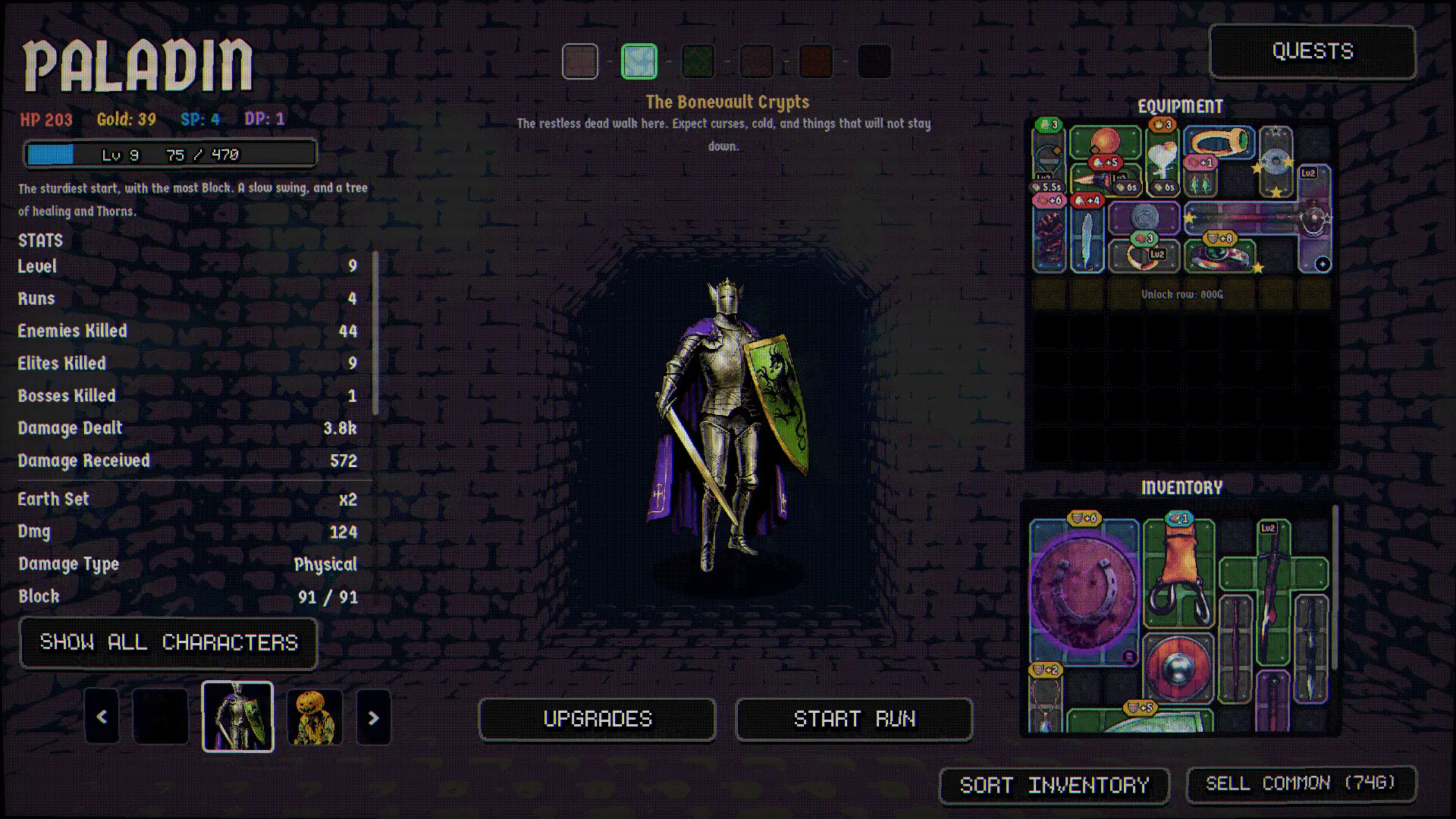
- Pick a hero you can evaluate. The official rosters are on our heroes page. For a first run, prefer a hero whose confirmed identity you can actually use - for example the Paladin’s published Block/healing/Thorns plan or the Archer’s bow-and-ammo plan - over a hero whose kit has not been detailed.
- Look at the board before the shop. Count the empty cells and the shapes you can fit. A powerful item that leaves a useless one-cell hole is often worse than a cheaper piece that completes a row.
- Buy one sustain source. Life steal, Regen, healing on trigger or a potion all count. The exact best source depends on your hero; the principle is that every long fight needs a way to recover.
- Buy space when space is the bottleneck. In the campaign, loadout space unlocks a whole row at a time. A new row can be worth more than a small stat upgrade because it lets you keep two effects instead of choosing one.
- Fight, then read the log. The battle log names the item that triggered, the status it applied and the damage it dealt. This is the fastest way to learn what your board is actually doing.
- Merge duplicates before the bag fills. Two identical items can become one stronger item up to level 10. Do it while you still have room to rearrange.
- Fuse only with a goal. “Save cells”, “combine two effects” or “keep a potion effect without the potion footprint” are goals. “It looks stronger” is how you lose a good parent piece.
A pre-release reviewer found that item tooltips list base stats, not the bonus from your hero’s affinity. They measured a frost item at 39 damage without the bonus and 47 with it. Until the launch build changes this, treat the tooltip as a floor, not the final number. See our affinity and set explanation.
Understand the three item verbs
Dungeonbound uses three different ways to turn junk into power, and they are easy to confuse.
Merge
Two identical items of the same level combine into one higher-level item, up to level 10. This raises the base stats and trigger scaling. It is the safest upgrade because you know exactly what the result is.
Fuse
The Fusion Forge combines any two different items into a hybrid. The hybrid inherits abilities from both parents. Since v0.1.51, the forge shows two variants and a before/after stat comparison, so you can inspect the result before you commit.
Fusion is the main answer to a full board. A reviewer fused a shield that occupied seven or eight cells into a two-cell hybrid that still provided block every six seconds, which freed the rest of the board for new gear. That is the real value: not raw power, but power per cell.
Dismantle
The Dismantle station destroys an item and absorbs some of its base attributes into the hero. It is not a fusion and it does not preserve the item’s trigger. Players have reported that it does not always absorb every stat group, so check the result screen rather than assuming the preview is complete.
Our fusion and merging guide covers the stations, curses, gems and potion interactions in detail.
Build a board, not a pile
A new player’s bag usually fills with the rarest items they found. A working board is different:
- Every cell should do something. Empty cells are fine only when you are saving for a specific shape.
- Placement is a mechanic. Some pieces care about what they touch, and an attack sweep fires items as it passes them. Moving a piece can change the order in which effects resolve.
- Tags act like sets. Gear carries affinity tags, and multiple pieces of the same tag can activate tiered bonuses. The game does not always explain this clearly; a reviewer discovered the set logic in hour five.
- Affinity is a multiplier on your plan. A hero’s affinity tags get a bonus. Matching your main damage tag to your hero is usually cheaper than fighting the affinity.
- Timed items play a different game. They fire on their own clock instead of waiting for the board sweep. Charge speeds them up; Slow and Stun hold them back.
- Runes are real estate. A rune is a 2x2 board square that powers the item covering most of it. Do not cover a rune by accident with a filler piece.
If you want a repeatable packing method, use the board-building guide. If you want to know what each status does before you commit, keep the status reference open.
Spend gold like the run is already lost
The most common economic mistake is buying a second damage item when the board cannot survive the first elite. A simple priority order:
- A sustain source that fits your hero.
- A row unlock if you are turning down good items because of space.
- A merge or upgrade on the item that already carries your damage or block plan.
- A counter item for the next dungeon’s theme - Burn ward before the Infernal Court, for example.
- A speculative synergy piece once the core works.
This is a planning order, not a hard rule. Shops are randomized, and the lucky shop can change the math. The point is to avoid spending your entire purse on a piece that cannot fit.
First-run checklist
- Choose one mode and one hero; write down the win condition before you descend.
- Put your main damage piece on the board before you buy a second one.
- Confirm at least one sustain source is active, not just sitting in the bag.
- Keep at least one row’s worth of space free for a merge or a shrine reward.
- Read the forge preview before every fusion.
- After each fight, check the log for the top damage and healing sources.
- Before the floor guardian, decide whether to spend or bank your gold.
- At the end of the run, record what killed you - that is the next run’s first purchase.
Seven mistakes that cost real progress
- Treating rarity as a build. A legendary piece that does not fit your tags or your plan can be worse than a common piece that completes a set.
- Splitting the Mage. Lightning, Frost and Fire each keep their own purchases. Spreading across all three is spreading a limited currency across three tracks.
- Fusing your only copy of a key item. The forge consumes parents. If an item is carrying your sustain or your block plan, merge a duplicate instead of experimenting on the original.
- Ignoring curses. Cursed items grant a boon and a real drawback, and forged items keep both parents’ curses. Read the red text.
- Hoarding potions for the old durability rules. Since v0.1.50, potions never break and refill every battle. The cost is space and gold, not permanence.
- Building for the fight you just won. The next floor’s theme changes the threat. The dungeon overview lists what each descent is built around.
- Copying a tier list from a pre-release build. Balance changed repeatedly in October and November. A build that was strong in v0.1.40 may have been directly nerfed by v0.1.46 or v0.1.50.
What is still unknown
Dungeonbound launches on November 15-16, 2026, and some information is still not public. We do not have a confirmed price, a full item list, a complete bestiary, or developer-published stat formulas. Anything that depends on those - a definitive tier list, exact best-in-slot boards, or per-hero level curves - will be added only after it can be sourced.
For the release timing and the time-zone table, see the release date page. For the demo’s scope, see the demo guide.
Sources & verification
Checked 2026-11-15- 01 Dungeonbound on Steam Official Store description, feature list, modes, system requirements, languages and release date.
- 02 Dungeonbound v0.1.50: Potions, Runes & Late Game + 40k wishlists Official Rune rework, potion rules, new hero Jeiku, forged-item growth, fatigue, speed curve.
- 03 Dungeonbound v0.1.51 + 55k wishlists + 7 days until launch Official Pricing indication ($10-12), item shrines, fusion preview, Loaded Dice, Jeiku, QoL and fixes.
- 04 Dungeonbound Review: The Bag Does the Fighting Press Pre-release impressions of the demo, including affinity tooltips, tag sets, fusion space savings and fatigue.
- 05 Official Steam store screenshot: Paladin hub and Bonevault Crypts Official screenshot Paladin description, quests entry, equipment grid, Bonevault Crypts atmosphere.
- 06 Official Steam store screenshot: dungeon shop Official screenshot Shop stock, prices, reroll cost and tag counters.
Screenshots and patch notes reflect pre-release builds. Where the launch build differs, the source label tells you how much weight to give a claim.
Quick answers
FAQ
Which Dungeonbound mode should a new player start with? +
If you want to keep progress while you learn, start with The Long Haul. If you want a clean roguelike run with five hearts and rival builds, start with The Climb. The game does not publish an official recommended order, so this is a preference call rather than a rule.
Does dying erase my progress? +
In The Long Haul, no: you keep loot, levels and permanent upgrades, and death is measured in floors. In The Climb, losing all five hearts destroys that run's build; only your rank carries between climbs.
Should I merge or fuse items first? +
Merge identical duplicates when you want a stronger version of a piece you already understand. Fuse when the board is out of space or you need two effects on one footprint. Always read the forge preview before committing, because fusion keeps both parents' curses and can produce two different variants.
Can I respec my Mage? +
The Mage has three subclasses - Lightning, Frost and Fire - and each keeps its own purchases. Switching subclasses is the respec: you do not erase the Mage or start over.
Keep reading