Crafting guide
Dungeonbound Fusion & Merging Guide: Forge, Curses, Gems & Potions
Dungeonbound gives you two ways to turn duplicates and junk into power, plus a bench full of stations that can improve, curse or dismantle a piece. Here is what each one actually does.
On this page +
Two verbs, two jobs
Dungeonbound’s crafting language is easy to mix up because both actions consume items and both produce a stronger piece.
Merging is the safe verb. Two identical items of the same level become one item of a higher level, up to level 10. You know the result; the only question is whether the item is worth the investment.
Fusion is the creative verb. The Fusion Forge combines any two different items into a hybrid that inherits abilities from both parents. Since v0.1.51, the forge shows two variants and a before/after stat comparison. This is the tool you use when the board is full but the shop keeps offering good pieces.
The rule of thumb:
- Merge when you want more of what you already have.
- Fuse when you need two effects in less space.
- Dismantle when you want base stats and do not care about the trigger.
What merging actually gives you
A merge:
- requires two identical items;
- raises the item’s level, up to 10;
- improves base stats and trigger scaling;
- does not consume extra inventory tiles beyond the resulting item;
- is the cleanest way to use duplicate drops.
The official patch notes add two important guardrails:
- Gems no longer stack up through merges (v0.1.51). A gemmed piece and a plain duplicate do not produce a double-gemmed result.
- Gemmed pieces merge with loot properly, according to the v0.1.40 fix list. If you are merging a socketed item, check the result rather than assuming the gem disappears.
Merging is also a quest engine. The Paladin quest Tempering asks for an item at level 7, and Grandmaster Smith asks for 100 item upgrades. Both reward you for doing something you already want to do.
What fusion inherits
The official description is broad: a hybrid inherits abilities from both parents. The patch notes add specifics:
- Curses are kept. Forged items keep both parents’ curses; the curse styling is preserved on the result.
- Bows keep their arrows. A bow fused with another item always keeps its arrows.
- Forged items grow every stat as they level. A hybrid is not a dead end; it can be upgraded and fused again.
- Potions can be fused into any item. The item keeps everything it does and gains the potion’s effect with Ammo that refills every battle.
- The forge can show two variants. You choose the result rather than accepting a single hidden outcome.
- The Mega Forge lists what you would lose. Use it before committing a high-investment piece.
A first-hand reviewer described fusing a shield that occupied seven or eight cells into a two-cell hybrid that still gave block every six seconds. That is the value proposition in one example: the hybrid did not need to be stronger than the shield; it needed to be smaller while preserving the job.
Fusion consumes both parents. If an item is your only sustain source, your only ammo source or your only copy of a quest item, fusing it can break the board even if the preview shows a higher stat total. Check the job, not just the number.
The stations around the forge
Dungeonbound has more crafting stations than the Fusion Forge. The confirmed ones:
| Station | What it does | Watch out for |
|---|---|---|
| Fusion Forge | Combines two different items into a hybrid with inherited abilities and two variants | Keeps both parents’ curses; consumes both parents |
| Mega Forge | A higher-tier forge that lists what you would lose | The loss preview is the point; read it |
| Upgrade Altar | Upgrades a single piece; since v0.1.51 it keeps the piece so you can upgrade again | Upgrades cost resources; not every item’s upgrade is worth it |
| Dismantle / Grinder | Destroys an item and absorbs base attributes into the hero | Players report it may not absorb every stat group; verify the result |
| Affinity Forge | Changes one of an item’s types to one of your hero’s types | Added in v0.1.46; useful for off-affinity gear |
| Sanctifying Altar | A new item shrine added in v0.1.51 | The exact effect is not fully documented yet |
| Gemcutter Bench | A new item shrine added in v0.1.51 | Gem socketing rules are still being documented |
| Gambler’s Forge | Takes potions; reusable for gold since v0.1.50 | Gambling can curse or break an item; it is not a safe upgrade |
| Curse shrine | Offers a cursed item with a boon and a drawback | The drawback is permanent on that item |
The station names are official. The exact odds, costs and full effect tables are not all public. We mark the gaps rather than filling them with guesses.
Curses: the real cost of a shiny item
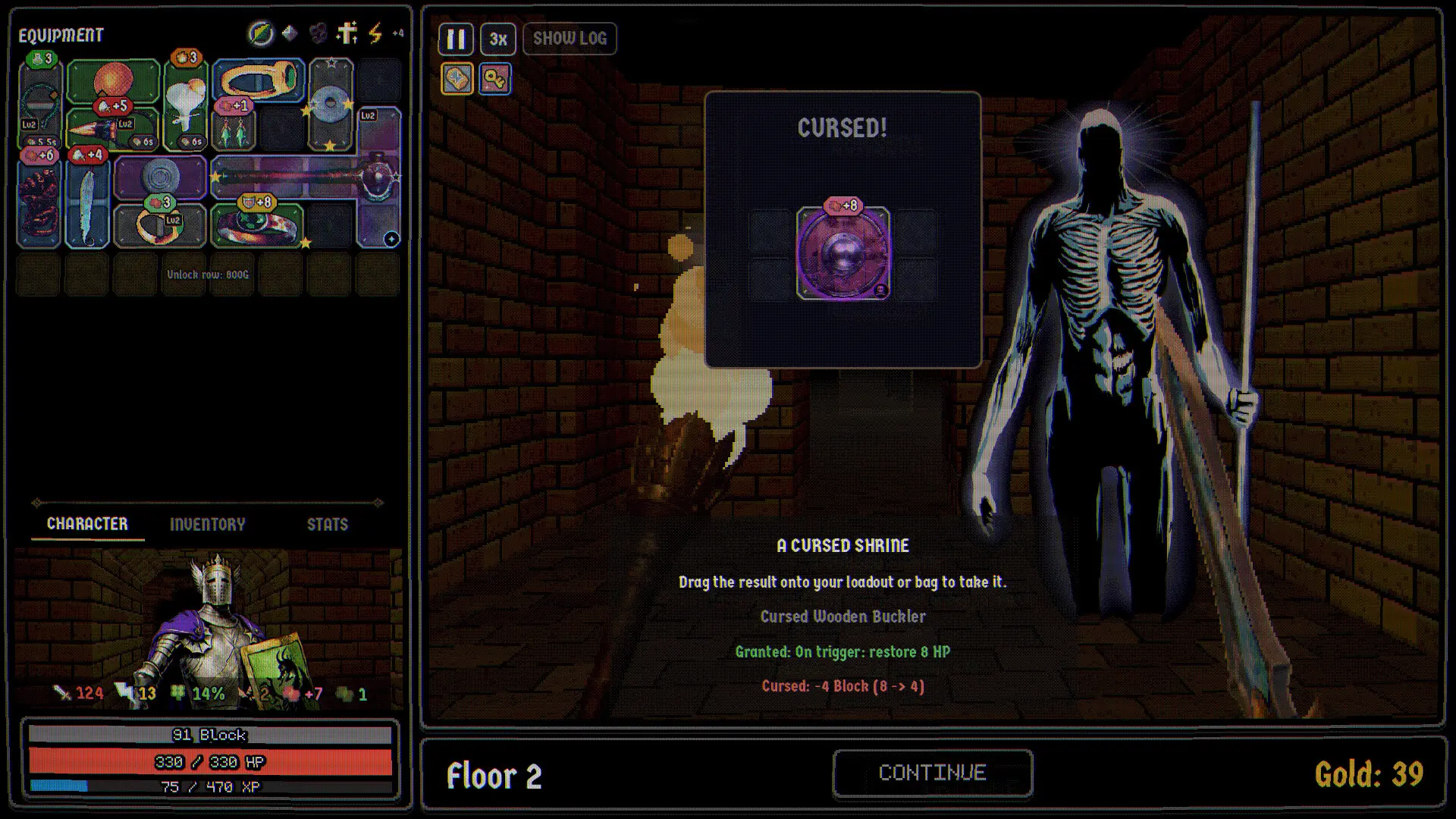
A cursed item gives you a genuine boon and a genuine drawback. The official screenshot shows a Cursed Wooden Buckler:
- Granted: On trigger, restore 8 HP.
- Cursed: -4 Block (8 -> 4).
That is a fair trade on a sustain board and a terrible trade on a pure block board. The item is not “good” or “bad” in isolation; it is good or bad for the job you need.
Rules that matter:
- Curses are kept on forged items. Fusing two cursed parents can produce a hybrid with both drawbacks.
- Luck no longer boosts curse drawbacks (v0.1.51). Do not build Luck expecting to erase the downside.
- Cursing an item again no longer multiplies its stats (v0.1.50 fix). Do not stack curses for a exploit.
- Curse quests exist. The Paladin’s Dark Bargainer (curse 5 items) and Hexbound (curse 15 items) reward you for using the shrine.
The right question is: can my board absorb the drawback? A -4 Block curse on a Paladin with 91 Block is a rounding error. The same curse on a low-block board is a real loss.
Gems, potions and bows
Gems
Gems socket into items and can change a piece’s job. The confirmed example is Fletcher’s Garnet, an Archer-only gem that adds ammo to a bow. The v0.1.40 notes say gems light up the pieces they can go into, and the v0.1.51 notes say gems no longer stack up through merges.
Practical rule: socket the gem after you finish merging, or verify the merge result. A gem is a commitment to the item’s role.
Potions
The potion rules changed substantially in v0.1.50:
- Potions never break.
- They refill every battle.
- Rarer potions are larger: Rare 1x3, Epic 2x2, Legendary and Alchemist-only 2x3.
- Potions can be upgraded, take gems and be forged.
- A potion fused into an item grants its effect with Ammo that refills every battle.
That last rule is the important one for board space: you can keep a potion’s effect without carrying the potion’s full footprint. The Alchemist is the specialist here; her cauldron only appears when she holds at least two real potions, and she throws her flask in combat.
Bows
A bow always keeps its arrows when forged. For an Archer, that means fusion does not strip the ammo engine. Fletcher’s Garnet adds ammo, and the v0.1.46 notes say arrow damage now counts toward the shot’s Dmg. Treat ammo as part of the weapon’s damage package, not a separate consumable.
A fusion decision flow
Use this before you press the button:
- Name the job. What does the hybrid need to do that the parents cannot do separately? “Save three cells” is a valid job. “Be purple” is not.
- Check the parents’ jobs. If either parent is your only sustain, only ammo or only cleanse, stop.
- Read both variants. Compare the stat deltas and the inherited abilities, not just the headline number.
- Check the curses. Both parents’ curses carry over. Can the board absorb them?
- Check the gems and potions. A gemmed parent may change the merge rules; a potion parent grants Ammo.
- Check the quests. A fusion may progress Master Melder (fuse 15 items) or Alchemist (fuse 5 items) on the Paladin. That can make a mediocre fusion worth doing for the unlock.
- Check the board. The result’s shape, not just its size, must fit. A two-cell hybrid that leaves a one-cell hole may be worse than a three-cell item that completes a row.
- Run the preview, then commit. If the preview does not answer the question, do not spend the parents.
The fusion helper turns this into a checklist with your selected goal and risks. It does not simulate stats; it makes sure you do not skip a step.
Five fusion mistakes
- Fusing two good items with no plan. You can lose both jobs and gain a stat stick.
- Ignoring the curse text. A hybrid with two drawbacks can be unusable on the board you actually have.
- Fusing before checking the Mega Forge. The Mega Forge exists to show you what you would lose.
- Socketing a gem before merging. Verify the merge result; gems do not stack through merges.
- Fusing a quest item. If a quest or NPC interaction needs the original, the hybrid may not count.
What we still don’t know
- The exact stat inheritance formula and whether any fusion resets level.
- The full list of fusion variants and how they are generated.
- Whether every item can be fused with every other item.
- The complete station costs, odds and quest interactions.
- Whether the Item Workshop’s custom items can be fused in ranked modes.
The official material gives us the rules of the verbs, not the full recipe book. We will expand this page when the launch build provides verifiable data. For the item list we can already source, see the notable items table.
Sources & verification
Checked 2026-11-15- 01 Dungeonbound on Steam Official Store description, feature list, modes, system requirements, languages and release date.
- 02 Dungeonbound Item Update v0.1.18 Official Timed items, six named timed pieces, loadout row unlocks, leaderboard and rival inspection.
- 03 Bug Fix Update 0.1.22: Item Crash Fixed Official Timed items scale with Speed, rarity labels, set tooltips, rival viewer.
- 04 Dungeonbound v0.1.40 Update + Mac Build for demo Official The Grave, speed baseline, item balance, climb win condition, Mac demo build.
- 05 Dungeonbound 0.1.46: Halloween Update Official Pumpkin Head, Haunted items, co-op lobbies, Mythic relics, PvE-only climbs, status changes.
- 06 Dungeonbound v0.1.50: Potions, Runes & Late Game + 40k wishlists Official Rune rework, potion rules, new hero Jeiku, forged-item growth, fatigue, speed curve.
- 07 Dungeonbound v0.1.51 + 55k wishlists + 7 days until launch Official Pricing indication ($10-12), item shrines, fusion preview, Loaded Dice, Jeiku, QoL and fixes.
- 08 Dungeonbound Review: The Bag Does the Fighting Press Pre-release impressions of the demo, including affinity tooltips, tag sets, fusion space savings and fatigue.
- 09 Official Steam store screenshot: cursed shrine Official screenshot Cursed Wooden Buckler example with boon and drawback.
- 10 Official Steam store screenshot: Paladin Quests Official screenshot Quest categories, objectives, rewards and item unlocks.
- 11 Official Steam store screenshot: dungeon shop Official screenshot Shop stock, prices, reroll cost and tag counters.
Screenshots and patch notes reflect pre-release builds. Where the launch build differs, the source label tells you how much weight to give a claim.
Quick answers
FAQ
How high can you merge an item in Dungeonbound? +
Two identical items combine into a higher-level version, up to level 10. The merged item gains base stats and trigger scaling.
What does fusion do? +
The Fusion Forge combines any two different items into a hybrid that inherits abilities from both parents. Since v0.1.51 the forge shows two variants and a before/after stat comparison.
Are curses kept when you fuse? +
Yes. The v0.1.50 notes state that forged items keep both parents' curses. Curse styling is also kept on the forged item.
Can you fuse potions? +
Yes. Since v0.1.50 a potion can be fused into any item. The item keeps everything it does and gains the potion's effect with Ammo that refills every battle. Potions can also be upgraded and take gems.
Does fusion reset the item's level? +
The public patch notes do not state a level reset. They do say forged items grow every stat as they level and hybrids can be fused again and leveled afterwards. Check the forge preview for the exact result in your build rather than assuming a rule.
Keep reading