Mode guide
Dungeonbound Climb Guide: Hearts, Relics, Rivals & Rank
The Climb is Dungeonbound's roguelike contract: five hearts, five relic picks, a floor full of shops and shrines, and somebody else's build waiting at the ladder. Here is how the run fits together.
On this page +
The contract
The Climb is a self-contained roguelike run. You start with a specialist hero, a purse and a board, then work upward through floors that each contain a shop, monsters, a shrine and rival builds. You have five hearts. Losing your last heart destroys the build. The only thing that comes home is your rank.
That last sentence is the whole mode. The Climb is not a place to protect an investment; it is a place to spend one. Gold, items and relics are run resources. Hoarding them is usually the losing move.
Five hearts, five relic picks, one rank
The official structure:
- Five hearts. A lost battle costs a heart; losing the last one destroys the run’s build.
- Five relic picks. On each of the first five floors, you choose one relic from three options. A relic stays with you for the whole climb and bends the run’s rules.
- Floor 8 is the promotion gate. Ranked climbs promote you at floor 8 and demote you when a run dies out. Winning means beating floor 8, not reaching it.
- The build is destroyed on the last heart. Rank is the only carry-over.
The practical consequence: your first four hearts are information, and your fifth is the run. Spend the early hearts to test the shop and the rival pool. Do not treat every floor as a must-win until the promotion is actually in reach.
A pre-release reviewer described losing a heart as being sent back to the start of the floor, and finishing a run at 142nd on the leaderboard after floor five took their last heart. That is a useful picture of the mode’s stakes: the leaderboard rewards depth, but a single bad matchup can end the climb.
What is on a floor
The Steam page describes each floor as a shop, monsters, a shrine and rival builds. The order matters for planning:
- Shop first. See what the floor is offering before you commit gold or a relic choice. A shop item can change which relic is correct.
- Monsters. Regular enemies and elites. From floor 4 onward, rivals replace monsters (a v0.1.46 change).
- Shrine. A run-modifying choice: an upgrade altar, a curse shrine, an affinity forge or another station. Read the cost, not just the reward.
- Rival builds. A snapshot of a real player’s board. Clearing the floor adds your own loadout to the pool.
- Guardian. The floor boss waits at the end.
Floor edge scaling is visible on rival panels. An official screenshot at floor 5 shows HP x1.25 and Dmg x1.25. That is the game telling you the floor itself is a multiplier; your board has to keep pace.
Relics change the rules, not just the numbers
The Climb’s relic picks are the closest thing to a class choice inside a run. Three confirmed examples from the official Choose a Relic screen:
- Leech Tooth - 10% chance to heal on attack.
- Coin Cache - gain 150 Gold right now.
- Ember Cloak - when hit, 25% chance to inflict 1 Burn on the attacker.
Notice that these are three different kinds of value: sustain, economy and retaliation. That is the decision the game is asking you to make on each of the first five floors. A damage relic is not automatically better than a gold relic if the gold lets you complete a board.
The Mythic tier sits above Legendary. Ancient Codex (5 levels), Prism of Kinship and Champion’s Laurel are the three named Mythic relics introduced in v0.1.46. Full effects for the latter two are not published yet, so we do not rank them. The relic database lists what is confirmed and what is still missing.
Since v0.1.51, quitting a climb early costs the floor 1 relic pick of your next climb. If you are losing, it is usually better to spend the remaining hearts and learn the rival pool than to abandon the run.
Rivals are the real difficulty curve
The Climb’s asynchronous PvP is not a side mode. Rivals block your way to every ladder, and each rival is a real build someone actually played: their hero, their board, item for item and rune for rune. Clear a floor and your own loadout is snapshotted into the pool to block somebody else’s climb later.
This produces two useful habits:
Scout before you start
The rival panel is a free intelligence report. In the official screenshot it shows:
- the rival’s hero and name, plus their level;
- their Max HP, Attack, Damage Type, Block, Block Chance, Block Regen, Magic Resist, Dodge and Crit;
- their affinity bonuses (for example, Undead / Frost +15%);
- their set counts (Arcane x1, Earth x1);
- their full board, item by item.
Read the damage type and the set counts first. A physical board into a high-Block rival is a different fight from a magic board into the same target. The combat guide explains how block, dodge and overkill interact.
Watch the replay
If you lose to a rival, you can watch the replay. That is not a consolation prize; it is the fastest way to see which of your items failed to fire, whether your sustain arrived too late, and which status actually killed you. Log the answer in the Climb tracker before you start the next run.
The “Jerry” placeholder
Several official screenshots show rivals named Jerry#8406, Jerry#2379 and similar. These appear to be placeholder or test-pool names in the pre-release build. Do not assume the launch pool will use them; the important detail is the snapshot behaviour, not the name.
Turn off two item types
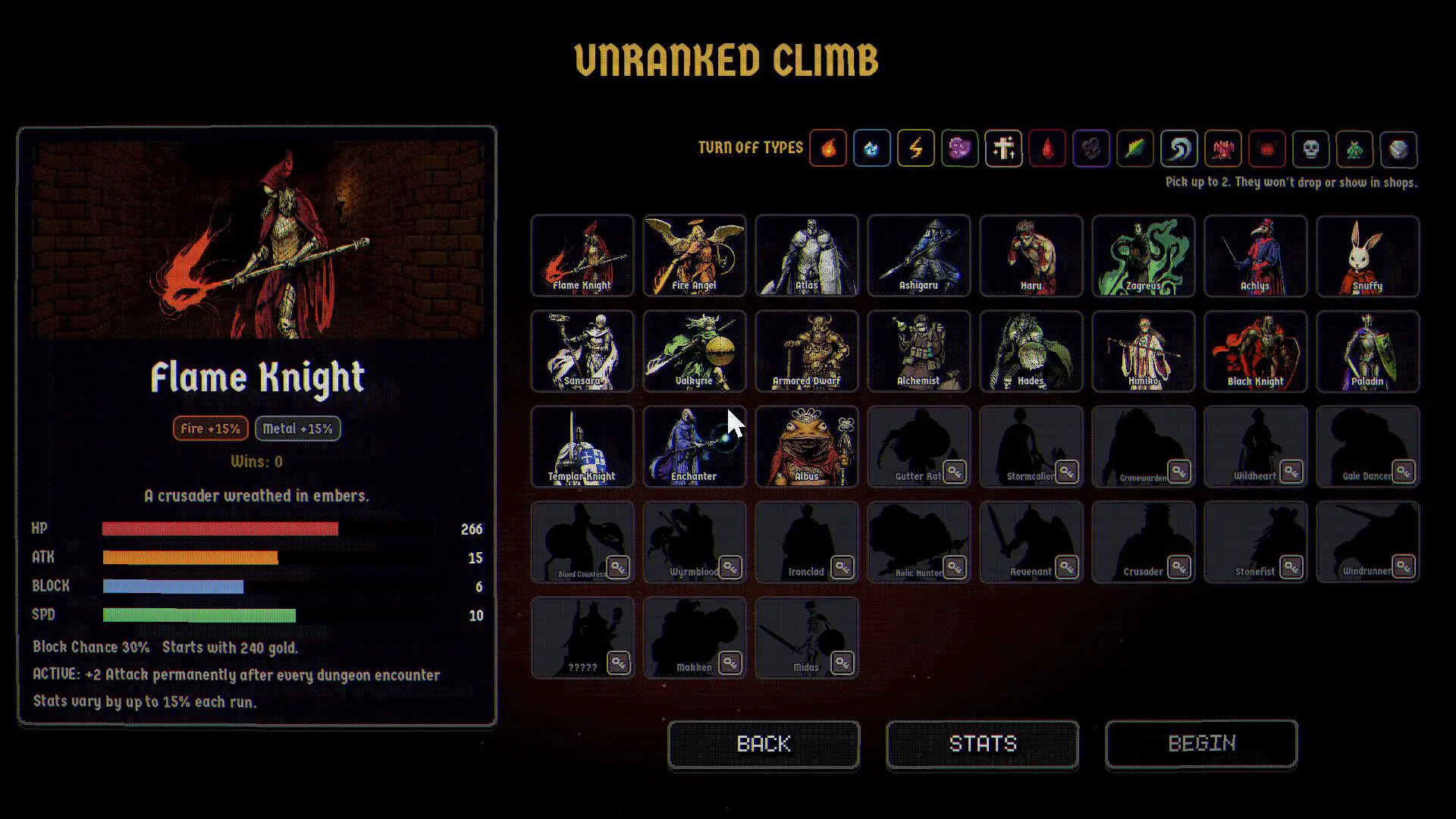
The Climb roster screen has a Turn Off Types control: pick up to two item types and they will not drop or show in shops. This is one of the most powerful decisions in the mode because it improves every future shop, not just the current floor.
Use it to remove:
- a tag your hero cannot use;
- a tag whose items you keep skipping because they do not fit your plan;
- a duplicate tag that dilutes the pool when you are chasing one specific synergy.
Do not use it to remove a tag just because you had one bad run. The ban is a commitment for the climb.
Build for the promotion, not the fantasy
A practical Climb plan:
- Commit to one damage tag and one sustain source by floor 2. The shop pool is wide; a focused board converts more of it into usable pieces.
- Buy space or a merge before a marginal upgrade. A full board turns good shop rolls into skipped gold.
- Take the relic that fixes your weakest floor, not the one with the biggest number. If you have no sustain, Leech Tooth is worth more than a damage relic.
- Scout the rival before you spend your last gold. The floor’s guardian and rival may want different defences.
- Keep one heart for the promotion attempt. If floor 8 is the gate, floor 7 is not the place to gamble on a coin-flip fusion.
- Record the result. Rank is the only thing that carries; a written note is the only thing that makes the next run better.
What we still don’t know
- The exact ranked ladder, rank names and demotion thresholds beyond floor 8.
- Whether every run offers the same relic pool or a hero-specific pool.
- The full 32+ specialist roster and each hero’s passive.
- Whether quitting penalties escalate beyond the floor 1 relic pick.
- The precise interaction between daily modifiers and ranked rank.
We mark these as unconfirmed rather than filling them with demo guesswork. The updates timeline records every official change that affects the mode.
Sources & verification
Checked 2026-11-15- 01 Dungeonbound on Steam Official Store description, feature list, modes, system requirements, languages and release date.
- 02 Dungeonbound v0.1.40 Update + Mac Build for demo Official The Grave, speed baseline, item balance, climb win condition, Mac demo build.
- 03 Dungeonbound 0.1.46: Halloween Update Official Pumpkin Head, Haunted items, co-op lobbies, Mythic relics, PvE-only climbs, status changes.
- 04 Dungeonbound v0.1.50: Potions, Runes & Late Game + 40k wishlists Official Rune rework, potion rules, new hero Jeiku, forged-item growth, fatigue, speed curve.
- 05 Dungeonbound v0.1.51 + 55k wishlists + 7 days until launch Official Pricing indication ($10-12), item shrines, fusion preview, Loaded Dice, Jeiku, QoL and fixes.
- 06 Official Steam store screenshot: Unranked Climb roster and Flame Knight panel Official screenshot Roster names, Flame Knight stats, type bans, and the "stats vary by up to 15%" note.
- 07 Official Steam store screenshot: Choose a Relic Official screenshot Leech Tooth, Coin Cache and Ember Cloak relic cards.
- 08 Official Steam store screenshot: rival scout panel Official screenshot Rival board, affinity, set counts, block, dodge, crit and floor edge stats.
- 09 Dungeonbound Review: The Bag Does the Fighting Press Pre-release impressions of the demo, including affinity tooltips, tag sets, fusion space savings and fatigue.
- 10 Feedback on Demo - Dungeonbound Steam Discussions Community Player-reported issues and impressions from the demo. Treated as community evidence, not fact.
Screenshots and patch notes reflect pre-release builds. Where the launch build differs, the source label tells you how much weight to give a claim.
Quick answers
FAQ
How many hearts do you get in The Climb? +
Five. Losing your last heart destroys the run's build. In co-op, the team shares the same five-heart pool.
When do you pick relics? +
You choose one relic from three options on each of the first five floors. The relic stays with you for the whole climb.
How does ranked promotion work? +
The Steam page says ranked climbs promote you at floor 8 and demote you when a run dies out. A v0.1.40 note clarified that winning a climb means beating floor 8, not merely reaching it.
Are the rivals real players? +
Yes. The Climb is asynchronous multiplayer. A rival is a snapshot of a real build someone played, including their hero, board, items and runes. Your own loadout is snapshotted into the pool after you clear a floor.
Can I turn off PvP? +
The Halloween update added PvE-only climbs with a boss every second floor, plus a Rival Fights on/off option. The default mode includes rivals.
Keep reading