Mode guide
Dungeonbound Long Haul Guide: Seven Heroes, Five Descents
The Long Haul is Dungeonbound's persistent campaign. Death costs floors, not your account. This guide explains what actually carries over, how the seven heroes differ, and where to spend gold and skill points first.
On this page +
What The Long Haul is
The Long Haul is the incremental half of Dungeonbound. You pick one of seven heroes, build a board, descend through a dungeon, and return to the hub with what you found. The official promise is simple: progress on one hero is never lost while you play another, and dying is a setback measured in floors, not hours.
That makes it the best mode for learning the item system. You can experiment with a fusion, discover that the result is worse than the parents, and still keep the levels and gold you earned along the way.
The trade-off is that The Long Haul asks more of your attention than an idle game. A pre-release reviewer noted that a Start Battle button waits before every encounter, so the mode does not fully play itself. That is a design preference, not a bug.
The seven heroes, and why switching is a commitment
The roster is Warrior, Mage, Rogue, Monk, Archer, Alchemist and Paladin. Each has their own gold pouch, level and permanent upgrades. The official page is explicit that switching heroes does not overwrite progress.
The practical consequence is more important than the feature list: you cannot farm gold on your main and hand it to a new hero. Every hero is their own economy. If you want to try the Alchemist, expect to start the Alchemist’s economy from the beginning.
That changes the right way to play:
- Pick one hero to be your main for the first several hours. Learn the dungeon layouts and the shop rhythm on a track that compounds.
- Treat a second hero as a new save, not a loadout swap. Play it when you want a different board puzzle, not because you are stuck.
- Spend permanent currency on the hero you are actually playing. A brilliant upgrade on a hero you have not unlocked yet does nothing.
For the confirmed identity of each hero, see the hero database. Only some heroes have enough official detail to plan around; we mark the rest as unconfirmed rather than inventing a kit.
The Mage is three tracks in one
The Mage is the exception to the “one hero, one economy” rule in spirit: it branches into Lightning, Frost and Fire, and each subclass keeps its own purchases. Switching is the respec. You do not erase the Mage or start over.
That is generous, but it is also a trap for new players. If you split purchases across all three schools, you have three half-built subclasses. Pick a school, build it until it works, then use the others as experiments. Our Mage subclass guide covers the decision in detail.
The five descents
The Steam page lists five named zones plus The Daily. They are not interchangeable skins; each advertises a different pressure.
| Descent | Official theme | What to prepare for |
|---|---|---|
| The Mudking Warrens | Kobolds, orcs and brutefolk in the mud | A mixed physical crawl; a clean place to learn board geometry |
| The Bonevault Crypts | Restless dead, curses and cold | Curse drawbacks and effects that do not stay down |
| The Chittering Deep | Beasts with deep health pools | Long fights that reward sustained damage and statuses |
| The Infernal Court | Demons that hit hard, crit often and burn everything | Burn wards, healing behind your block, crit spikes |
| The Wyrmroost | The dragons at the bottom | The final listed descent; no official dragon mechanics published yet |
The exact unlock order is not documented in the public material. The order above follows the Steam page’s listing, not a confirmed progression gate. Our dungeon database keeps the official descriptions and the planning implications in one place.
The death loop, without the marketing
The official loop is: descend, fight, bank loot, spend gold, buy upgrades, rework gear, descend again. Losing a run returns you to the hub with your loot, levels and upgrades.
Two demo-era details are worth knowing, but label them as community observation:
- A reviewer reported that each campaign run gives you one life and one weapon, with health carrying between fights rather than resetting.
- The same reviewer reported the next inventory row cost 800 gold at their point in progression. Row costs scale; do not treat 800 as a universal price.
If those rules survive launch, they push the campaign toward a careful attrition plan rather than a series of disposable runs. One weapon means your weapon slot is a long-term commitment. Health carrying between fights means a small chip-damage problem becomes a real problem over a floor.
Where the permanent upgrades go
The Steam page sorts 400+ permanent upgrades into five categories:
- Damage - flat damage, crit, execute thresholds and tempo tools.
- Defense - block, armour, resistances and dodge.
- Sustain - life steal, regeneration, healing on kill and cleansing.
- Economy - gold drops, shop discounts and luck.
- Unlocks - class unlocks, weapon slots and board rows.
A practical spending order for a new campaign:
- Unlock the next row when the board is the reason you are declining good items. Space compounds: every future item, rune and fusion is easier to place.
- Buy one reliable sustain node before buying a second damage node. The status reference explains why long fights punish a pure block plan.
- Improve your main damage engine - the item or tag you already build around, not a hypothetical future drop.
- Buy economy only after the board functions. Extra gold is excellent, but it cannot fix a board that dies on floor two.
- Leave speculative unlocks for last. A new weapon type is only worth it if you have the space and the support gear to use it.
This is a framework, not a spreadsheet. The game does not publish upgrade costs or level curves, so any exact “best purchase” claim before launch would be invented.
The board still decides everything
The Long Haul changes the stakes, not the core combat rules. Attacks still resolve on speed-driven turns, items still fire as the attack sweep passes them, and the board still has to fit.
That means the board-building guide applies here more than any hero-specific trick. The short version:
- Use the grid’s shape, not just its size. A large item that blocks two smaller synergies can be a downgrade.
- Match your hero’s affinity when you can. A reviewer measured a frost item at 39 damage without the hero’s affinity bonus and 47 with it - a real gap that the base tooltip did not show.
- Treat tags as sets. Multiple pieces with the same tag can activate tiered bonuses; the game does not always make this obvious.
- Do not cover a rune by accident. Runes are 2x2 squares that power the item covering most of them.
- Merge duplicates before the bag fills; fuse when you need two effects on one footprint.
Quests are part of the progression
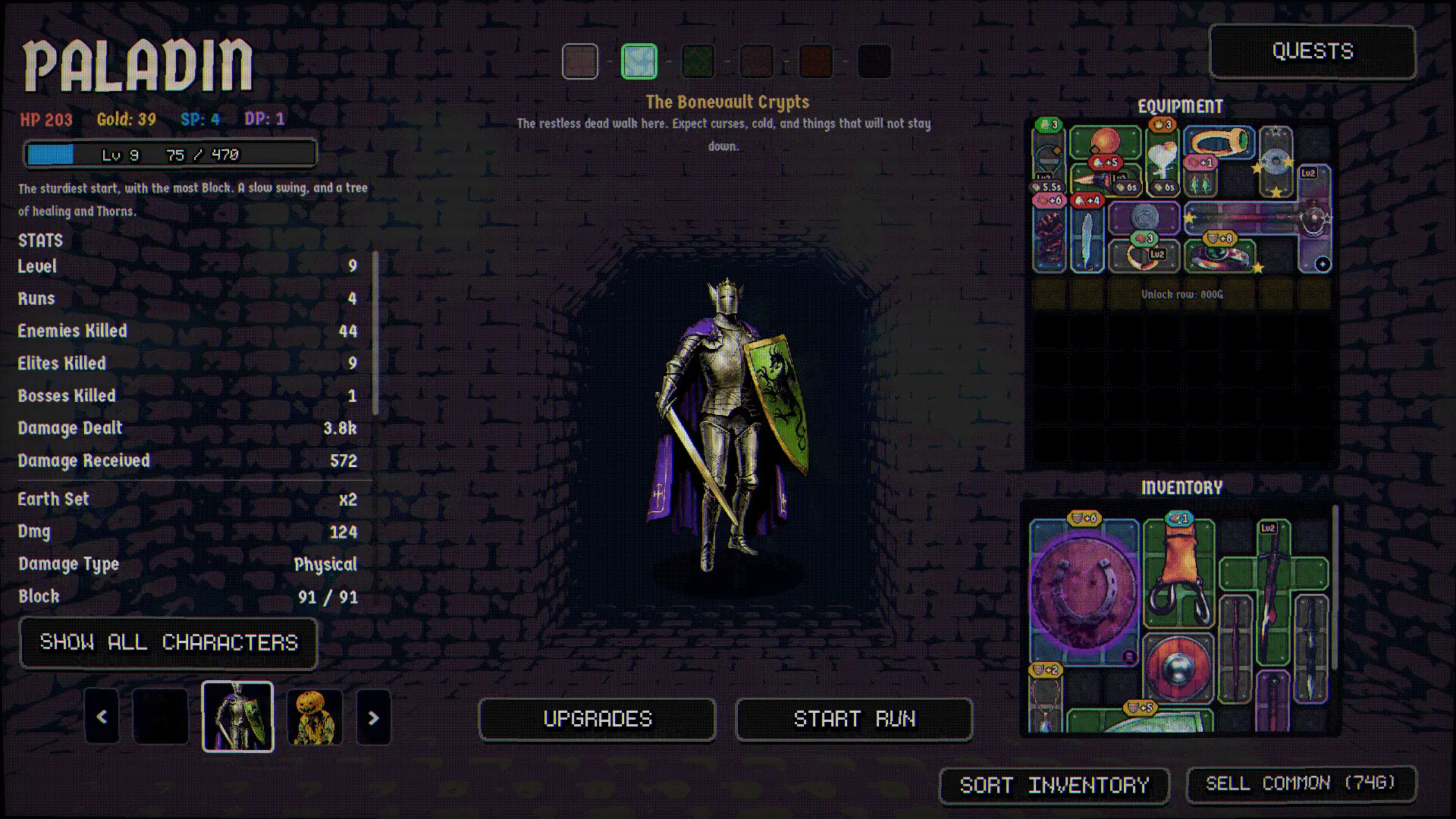
The official Paladin quest screen shows 28 quests split into Combat, Items and General, with rewards including Skill Points, gold and permanent item unlocks. Examples visible in the screenshot include:
- Tempering - get an item to level 7, reward +3 SP.
- Master Melder - fuse 15 items at the forge, unlock Emberbreaker.
- Hexbound - curse 15 items, unlock Storm Sabre.
- Plaguebringer - inflict 500 status effects, unlock Venom Claw.
Only the Paladin page has been shown publicly. We do not know whether every hero has 28 quests or whether the objectives repeat. The safe reading is that quests reward the exact behaviours the hero wants you to practise: cursing, fusing, upgrading and applying statuses.
Common Long Haul mistakes
- Spreading gold across three heroes. Each purse is separate. Pick a main.
- Buying a rare item that does not fit. Rarity is not a board plan.
- Ignoring the quest tab. It is a free source of SP, gold and item unlocks tied to actions you are already doing.
- Skipping the log. The battle log is the only reliable way to see which item is carrying the fight.
- Fusing the only copy of a sustain piece. Merge a duplicate or wait for a second copy.
- Assuming The Long Haul is fully idle. It still asks for a battle confirmation each encounter, at least in the demo build.
What we still don’t know
- The exact unlock order for the five descents.
- Whether The Long Haul has an endless or post-campaign mode at launch.
- Whether rival builds appear in the campaign.
- The full quest list for heroes other than the Paladin.
- Upgrade costs, level caps and difficulty scaling.
We will update this page when the launch build provides sourced answers. For the date and unlock time, see the release page.
Sources & verification
Checked 2026-11-15- 01 Dungeonbound on Steam Official Store description, feature list, modes, system requirements, languages and release date.
- 02 Dungeonbound v0.1.40 Update + Mac Build for demo Official The Grave, speed baseline, item balance, climb win condition, Mac demo build.
- 03 Dungeonbound 0.1.46: Halloween Update Official Pumpkin Head, Haunted items, co-op lobbies, Mythic relics, PvE-only climbs, status changes.
- 04 Dungeonbound v0.1.50: Potions, Runes & Late Game + 40k wishlists Official Rune rework, potion rules, new hero Jeiku, forged-item growth, fatigue, speed curve.
- 05 Dungeonbound v0.1.51 + 55k wishlists + 7 days until launch Official Pricing indication ($10-12), item shrines, fusion preview, Loaded Dice, Jeiku, QoL and fixes.
- 06 Dungeonbound Review: The Bag Does the Fighting Press Pre-release impressions of the demo, including affinity tooltips, tag sets, fusion space savings and fatigue.
- 07 Official Steam store screenshot: Paladin hub and Bonevault Crypts Official screenshot Paladin description, quests entry, equipment grid, Bonevault Crypts atmosphere.
- 08 Official Steam store screenshot: Paladin Quests Official screenshot Quest categories, objectives, rewards and item unlocks.
Screenshots and patch notes reflect pre-release builds. Where the launch build differs, the source label tells you how much weight to give a claim.
Quick answers
FAQ
What do you keep when you die in The Long Haul? +
Loot, hero levels and permanent upgrades, according to the official Steam page. Death is a setback measured in floors rather than hours. Gold spending and board changes are made back at the hub.
Is gold shared between Long Haul heroes? +
No. Each of the seven heroes has their own gold, levels and permanent upgrades. Progress on one hero is never lost while you play another, but it also does not transfer.
How many permanent upgrades are there? +
The Steam page documents over 400 permanent upgrades across five categories: Damage, Defense, Sustain, Economy and Unlocks.
Does The Long Haul have other players' builds? +
The official page assigns asynchronous rival builds to The Climb. A pre-release reviewer reported that the incremental mode only put regular monsters in front of them. Treat rival encounters in The Long Haul as unconfirmed until the launch build is checked.
Keep reading