Enemy database
The dungeon does not fight fair
Dungeonbound documents 240+ hand-painted enemies, 49 elites and 17 bosses. It does not publish a stat sheet for them. This page covers the archetypes the developer has confirmed and the scouting habits that beat them.
- Enemies
- 240+
- Elites
- 49
- Bosses
- 17
- Named here
- 8 archetypes
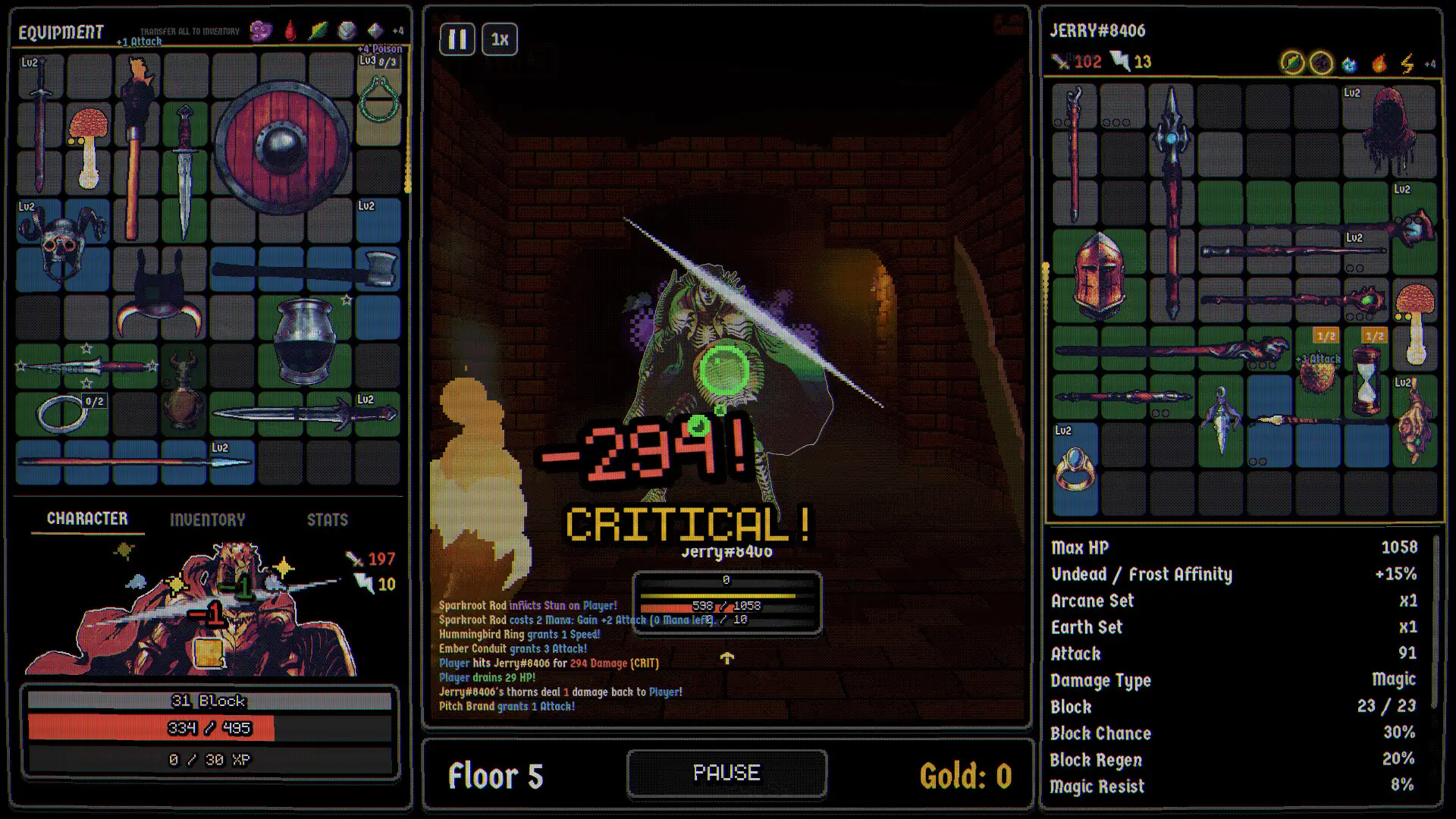
Official Steam screenshot
Threat summary
- Regular
- 240+ total
- Elites
- 49
- Bosses
- 17
- PvP
- Async snapshots
Counts are from the official Steam page. Boss names and stats are not published.
Confirmed archetypes
What the developer says they do
These are not guesses from a screenshot. Each archetype is named in the official Steam description; the counter is our planning response to the confirmed behaviour.
Thorns
Official Steam page
Tell: Reflects damage when you hit it.
Response: Use fewer, larger hits and add healing or lifesteal. A multi-trigger board can kill itself on a Thorns pack.
Berserkers
Official Steam page
Tell: Grows stronger the longer the fight runs.
Response: Front-load damage. Do not bring an attrition board and expect to outlast it.
Bloodthirsty
Official Steam page
Tell: Heals off the wounds it inflicts.
Response: Burst it down or apply Unhealing. Chip damage feeds it.
Thieves
Official Steam page
Tell: Flees with your gold.
Response: Prioritise it before the payday disappears. The official page does not publish a flee timer.
High Block
Screenshot / combat rules
Tell: A physical wall with a large Block pool.
Response: Check your damage type and status plan. A physical-only board can stall out and hit Fatigue.
Evasive
Official patch notes
Tell: High Dodge, low raw defence.
Response: Freeze lowers Dodge (v0.1.50). Multi-hit or accuracy pressure is the natural answer.
Status-heavy
Official patch notes
Tell: Burn, Poison, Bleed, Stun or Terror stacks.
Response: Cleanse, ward and sustain. Burn wards block 50% of Burn damage after v0.1.46.
Rival builds
Official Steam page
Tell: A real player's board, stats, sets and relics.
Response: Scout the damage type and block before the fight; watch the replay if you lose.
Named enemies in official media
A few enemies are visible by name in official screenshots. They are not a bestiary; they are examples of the art and naming style:
- Court Mage - a robed caster in the Infernal Court screenshot.
- Serpent Knot - a mass of snakes with a deep health bar in the same encounter.
- Knight of the Starless Oath - a skeletal knight that dropped 55 gold and a Grinding Stone in the blacksmith screenshot.
We do not list stats, weaknesses or drops for these enemies because the public material does not provide them. The screenshot is a moment, not a stat block.
Rival builds are the real difficulty spike
In The Climb, the hardest enemy is often another player. Rivals are real builds snapped with their hero, board, items and runes. The scout panel gives you a free intelligence report before the fight:
- Damage type - physical or magic. A physical board into a high-Block rival is a different fight.
- Block, Block Chance and Block Regen - a block wall without regen can be worn down; one with regen cannot.
- Dodge and Crit - tells you whether the fight is about accuracy or burst.
- Affinity and set counts - a rival with a stacked set is using a board-wide multiplier, not just good items.
- Board layout - where the sustain, the damage engine and the runes sit.
If you lose, watch the replay. The battle log tells you which of your items failed to fire and what actually killed you. Record it in the Climb tracker before the next run.
How to build a counter, not a bigger number
- Identify the damage source. Is it direct hits, a status tick, or a scaling berserker?
- Pick the cheapest answer. A Burn ward, a cleanse or a Freeze can be cheaper than out-statting the enemy.
- Check the clock. If the fight is long, fatigue and healing matter. If it is short, front-loaded block and burst matter.
- Do not over-commit. A counter that only works against one enemy is a wasted board slot if the next floor is a different theme.
What we still don't know
- The full enemy list, stats and drop tables.
- Boss names, mechanics and elemental resistances.
- Elite modifiers and whether they are fixed or random.
- Exact thief flee rules and gold-loss amounts.
- Whether rival snapshots are filtered by floor, rank or hero.
Sources & verification
Checked 2026-11-15- 01 Dungeonbound on Steam Official Store description, feature list, modes, system requirements, languages and release date.
- 02 Official Steam store screenshot: combat and battle log Official screenshot Court Mage and Serpent Knot encounter, critical hit, burn and item trigger log.
- 03 Official Steam store screenshot: rival scout panel Official screenshot Rival board, affinity, set counts, block, dodge, crit and floor edge stats.
- 04 Dungeonbound 0.1.46: Halloween Update Official Pumpkin Head, Haunted items, co-op lobbies, Mythic relics, PvE-only climbs, status changes.
- 05 Dungeonbound v0.1.50: Potions, Runes & Late Game + 40k wishlists Official Rune rework, potion rules, new hero Jeiku, forged-item growth, fatigue, speed curve.
- 06 Dungeonbound v0.1.51 + 55k wishlists + 7 days until launch Official Pricing indication ($10-12), item shrines, fusion preview, Loaded Dice, Jeiku, QoL and fixes.
- 07 Feedback on Demo - Dungeonbound Steam Discussions Community Player-reported issues and impressions from the demo. Treated as community evidence, not fact.
Screenshots and patch notes reflect pre-release builds. Where the launch build differs, the source label tells you how much weight to give a claim.